The basket is a small part with a big job. It holds your coffee. It also shapes how water moves through the puck. Change the basket and you change the shot.
This guide covers the main basket types. It starts with the stock basket that comes with your machine. It ends with the stepped-down basket, a newer idea that has people grinding coarser.
Why the basket matters
The basket sets three things: the shape of the coffee bed, the size and pattern of the holes, and how much coffee it holds.
A wide, shallow bed lets water pass through quickly. A narrow, deep bed gives water a longer path. The holes in the base decide how evenly water leaves the puck. Uneven holes can mean uneven flow.
Most home machines ship with a decent but basic basket. That is fine to learn on. Upgrades help most once your grind, dose and puck prep are already steady. If they are not, start with the puck prep guide.
Stock, pressurized and single-wall baskets
Start with the two baskets that ship in the box with many entry-level machines.
Pressurized (dual-wall) baskets have a tiny single exit hole, or a second wall, that builds back-pressure. That back-pressure creates foam on top of the shot, even when the grind is too coarse or the coffee is stale. These baskets forgive mistakes. They also hide detail in the cup.
Non-pressurized (single-wall) baskets have many small holes in the base. Nothing hides the grind. If the grind is wrong, the shot tastes wrong. If the grind is right, the cup is clearer and more detailed.
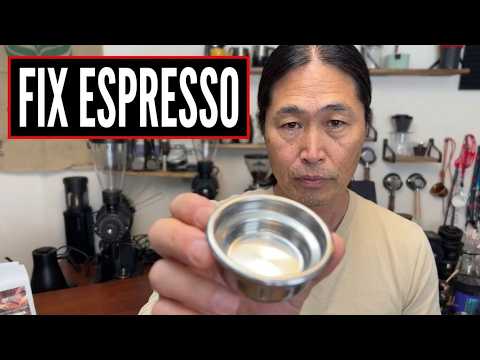
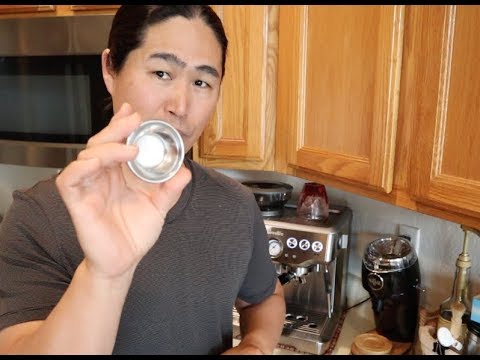
Hoon covers the difference in several Breville Barista Express videos, including the two below.
He also made a longer walkthrough, "Breville BES870 | Filter Baskets Explained | Breville Barista Express", which you can find in the video library.
Precision and high-yield baskets
A precision basket has holes that are cut to tight, even tolerances. Stock baskets can have holes with rough edges or uneven spacing. Precision baskets aim for a more even flow through the puck. Many are made from stainless steel and have a flat base.
A high-yield (or high-extraction) basket is built to hold more coffee in the same portafilter. It also aims to improve extraction evenness. The exact shape depends on the maker. Some are straight-walled. Some are tapered.
Brands like Pesado and Saint Anthony Industries make baskets for home machines. Hoon partners with both.
Hoon asks the honest question about a premium basket in this video.
Watch it to see how he frames the decision. The short version for you: a better basket cannot fix an inconsistent grind or a messy puck. It makes a good routine a little better.
The stepped-down basket
The stepped-down basket is a different idea. The top of the basket matches your portafilter. The lower section steps down to a narrower diameter.
According to the description of Hoon's video, one example steps from 58 mm down to 46 mm. The puck becomes narrower and deeper. The 58 mm portafilter stays the same. That means your tamper, group head and machine do not change.
In that video, Hoon explores how a deeper bed forces you to grind coarser and how it affects contact time. He also asks whether the result is sweeter, richer and less astringent. Watch his tasting before you decide.
Here is the reasoning behind it:
- A deeper bed offers more resistance, so water slows down.
- To keep the shot running at a normal time, you grind coarser.
- A coarser grind makes fewer fines, which can mean a cleaner cup.
- A narrower puck can also be easier to keep even, but this depends on your prep.
Treat these points as the theory. Your results will depend on your grinder and coffee.
How to choose
Match the basket to your problem, not to hype.
| If you have | Consider |
|---|---|
| A new machine and a pressurized basket | Learn on it, then move to single-wall |
| A single-wall basket and uneven shots | Fix prep first, then try a precision basket |
| A good grinder and a wish for more yield or clarity | A high-yield basket |
| A light roast that gushes or tastes sharp | A stepped-down basket, with a coarser grind |
Check that a basket matches your portafilter size and machine before you buy. A 54 mm basket will not fit a 58 mm portafilter. Dose range matters too. Most baskets list a range, and you get the best result near the middle of it.
Switch baskets the right way
Change one thing at a time. If you swap baskets and adjust the grind and the dose together, you cannot tell which change helped.
- 1Pull three shots with your old basket. Note the dose, yield and time.
- 2Swap in the new basket and keep the dose the same.
- 3Pull a shot. Expect the flow to change.
- 4Adjust the grind until the shot time is close to your old one.
- 5Taste both baskets side by side, in the same hour, with the same beans.
- 6Only then change your dose or ratio.
Next steps
- Dial in step by step with the Breville Barista Express tutorial.
- Fix problem shots with sour or bitter espresso.
- Learn about coarser grinding in modern espresso.
- Try the dial-in calculator to track your shots.
- Browse all baskets and gear and the partners page.
Written for this fan-built hub from Hoon's public videos; numbers are starting points, and your beans, grinder and taste have the final say.