Your espresso tastes wrong. It makes your mouth pucker, or it leaves a dry, harsh finish. You are not alone. Almost every home barista meets sour and bitter shots early on.
The good news: taste is a clue. Each flavor points to a likely cause and a likely fix. This guide gives you a decision list you can follow shot by shot.
What sour and bitter really mean
Coffee extraction is a simple idea. Hot water pulls flavors out of the grounds. It pulls out different things at different times.
- Early in extraction, water pulls out acids and light fruity compounds.
- In the middle, it pulls out sugars and body. This is where the sweet, balanced flavor lives.
- Late in extraction, it pulls out heavier compounds. Too many of these taste dry, harsh, and bitter.
So a sour shot is usually under-extracted. The water did not pull enough. A bitter shot is usually over-extracted. The water pulled too much, or pulled unevenly.
This is a rule of thumb. Bad beans, old beans, a dirty machine, or very dark roast can also taste bitter or sour for other reasons. Start with the extraction idea, then look wider.
The decision list
Follow these steps in order. Stop when your shot tastes good.
- 1Check your basics. Use fresh beans, a scale, and a timer. Weigh your dose. Weigh your output. Keep the same dose each shot.
- 2Taste the shot. Does it taste sour, bitter, or both?
- 3If it is sour: grind finer by one step. Pull another shot. If it is still sour, go finer again.
- 4If it is bitter: grind coarser by one step. Pull another shot. If it is still bitter, go coarser again.
- 5If it is both sour and bitter: this often means uneven extraction, also called channeling. Improve your puck prep (see below) before you change the grind.
- 6If the shot runs very fast and still tastes bitter: the water may be racing through cracks. Look at puck prep and your basket.
- 7If the time is right but the cup tastes dull: try a longer ratio, such as 1:2.5, or check bean freshness.
- 8Change only one thing between shots. Write down each change.
Cheat sheet: taste, likely cause, fix
| Taste | Likely cause | Fix to try first |
|---|---|---|
| Sour, sharp, thin | Under-extracted. Grind too coarse or shot too short | Grind finer or run the shot longer |
| Salty, watery, empty | Very under-extracted. Shot ran far too fast | Grind finer, check dose |
| Bitter, dry, harsh | Over-extracted. Grind too fine or shot too long | Grind coarser or stop the shot sooner |
| Ashy, burnt | Very dark roast, old oil, or dirty machine | Grind coarser, use a lower temperature if you can, and clean your gear |
| Sour and bitter together | Uneven extraction (channeling) | Improve distribution and tamp |
| Flat, dull, papery | Stale beans or water too soft | Use fresher beans, check your water |
| Muddy, heavy | Too much coffee in the basket or very fine grind | Check dose, grind coarser |
Treat this table as a starting point. Beans, machines, and palates differ.
Fixing sour espresso
Sour is the most common problem on entry-level machines. A few things to try:
- Grind finer. This slows the shot and gives the water more time to pull flavor.
- Increase the shot weight. A longer shot extracts more. Move from 1:2 toward 1:2.5.
- Check the dose. A very low dose in a big basket can make the shot run fast.
- Check the water. Very soft or filtered water can taste thin and sour. See Water for coffee.
- Check the roast. Light roasts are dense. They often need a finer grind and a longer shot than dark roasts.
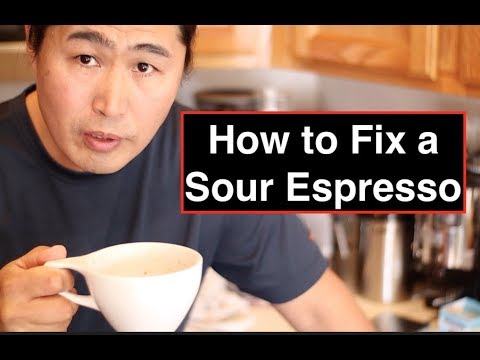
In Why Your Espresso Tastes Sour (And How to Fix It), Hoon explains why espresso tastes sour and how to fix it.
If you own a Barista Express, he also made a version for that machine: How to Fix a Sour Espresso - Breville Barista Express.
Fixing bitter espresso
Bitter shots often come from grinding too fine or running the shot too long. Try this:
- Grind coarser by one step. The shot will run faster.
- Stop the shot sooner. A 1:1.5 or 1:2 ratio often tastes sweeter than a 1:3 shot.
- Check for channeling. Cracks in the puck let water rush through one area. That area over-extracts while the rest under-extracts.
- Clean your machine. Old coffee oils taste rancid and bitter. Backflush and rinse your portafilter and shower screen often.
- Check the beans. Very dark roasts can taste bitter even when you extract them well.
In The Ultimate Guide to Fixing Bitter Espresso (Breville Edition), Hoon guides viewers through fixing bitter espresso on a Breville.
When the shot tastes fine but not like the bag
Sometimes a shot is balanced and sweet, yet it does not taste like the notes on the bag. That is not a failed shot. Roasters often write tasting notes from cupping, which is a different brew method than espresso.
Hoon's video Stop Expecting Your Espresso to Taste Like the Bag explains why tasting notes can mislead when you brew espresso. Judge the shot by balance and sweetness first.
A fast reset
If you feel lost, reset.
- 1Pick a recipe: 18 g in, 36 g out.
- 2Set your grind in the middle of its range.
- 3Pull a shot. Note time and taste.
- 4Move one step finer if sour. Move one step coarser if bitter.
- 5Repeat until it tastes balanced.
For a method that works on any grinder, see Hoon's video Stop Struggling: How to Dial In Espresso on Any Machine or Grinder.
Next steps
- Learn the full loop in Dialing in espresso on a Breville Barista Express.
- Improve your puck prep with Puck prep: distribution, tamping and puck screens.
- Try the Dial-in calculator.
- Check your water.
- Browse more fixes in the video library.
Written for this fan-built hub from Hoon's public videos; numbers are starting points, and your beans, grinder and taste have the final say.