Pour over looks simple. You put coffee in a paper filter, pour hot water on top, and wait. Yet small habits make a big difference in the cup.
This guide covers the basics that work with any dripper. It does not matter if you use a Hario V60, a flat-bottom brewer, or a Cafec Deep 27. The same fundamentals apply. Once you have them, you can tweak the details.
The five things that matter
Pour over has many variables. Five of them do most of the work.
- 1Ratio. How much water you use for the coffee you dose.
- 2Grind size. How coarse or fine the grounds are.
- 3Water. Its temperature and its mineral content.
- 4Filter paper. Its shape, thickness, and rinse.
- 5Pouring. How fast you pour and how much you disturb the bed.
Change one at a time. This is the same advice as for espresso: you learn more when you only move one variable.
Start with a ratio
A good starting ratio is about 1:16. That means 16 g of water for every 1 g of coffee. For a single cup, 15 g of coffee and 240 g of water is a handy example.
Many brewers go stronger or weaker. A ratio of 1:15 tastes stronger. A ratio of 1:17 tastes lighter. Treat these as starting points.
A scale is the best tool you can buy for pour over. It lets you repeat a good cup. Without it, every brew is a guess. Gear like the Acaia scale is common, but any scale that reads to 0.1 g and has a timer helps.
Some brewers use unusual ratios. In Why Your Pour Over Recipe Needs a Reset: The 1:10 Ratio, Hoon tries a modification of Simon Gautherin's 2026 World Brewers Cup routine. It is a good reminder that the ratio is a lever you can pull.
Grind and water
For pour over, you want a medium-fine grind. It should look like table salt or a little coarser. If your brew drains too fast and tastes sour, grind finer. If it drains too slowly and tastes bitter or dry, grind coarser.
For water, use clean water that tastes good. Very soft water can taste flat. Very hard water can taste dull and chalky. Read Water for coffee for more.
A common starting temperature is just off the boil, around 93 to 96 C (200 to 205 F). Lighter roasts like hotter water. Darker roasts can taste better a little cooler.
Pick and prep your paper
Filter paper changes the flavor and the flow. Thin papers flow quickly. Thick papers flow more slowly and can give a cleaner cup.
Always rinse the paper with hot water before you add coffee. This removes the papery taste and warms the brewer. Dump the rinse water before you brew.
Paper shape and fold matter too. In V60 Paper Hack (T90) | Flat Bottom Filter paper fold, Hoon shows how to fold a V60 filter using a flat-bottom dripper. The video also lists a few tools he uses, such as Cafec T90 paper. See also the Cafec T90 filter paper page.
A simple recipe to follow
Use this for any dripper. Adjust the numbers to match your brewer.
- 1Heat your water. Set up your brewer on a scale over a mug or server.
- 2Place the paper in the brewer and rinse it with hot water. Discard the rinse water.
- 3Add 15 g of ground coffee. Shake the brewer gently to level the bed.
- 4Tare the scale. Start the timer.
- 5Bloom: pour about 45 g of water over the grounds. Make sure all the coffee is wet. Wait 30 to 45 seconds.
- 6Main pour: pour slowly in small circles to reach 240 g. Aim to finish by about 2:00.
- 7Let the water drain. Total time is often about 2:30 to 3:30.
- 8Swirl the brewer gently, then remove it. Taste the cup.
These numbers are a starting point. If the cup is sour, grind finer or pour slower. If it is bitter, grind coarser or pour faster.
Bloom and agitation
The bloom is a short first pour that lets trapped gas escape. Fresh coffee releases more gas. Without a bloom, the gas can push water around the grounds and cause uneven extraction.
Agitation is anything that stirs the bed: swirling, stirring, or a forceful pour. More agitation usually means more extraction. If your cup tastes sour, a swirl or a stir after the bloom can help. If it tastes harsh, try less.
Hoon ran a stream called High Agitation vs. No Agitation Pour Over: The Ultimate Flavor Showdown that compares the two ideas.
Brewer shape and angle
Different brewers flow differently. A cone brewer like the Hario V60 has a single large hole and ridges. Flow depends on grind and pour. A flat-bottom brewer spreads water across a wider bed. A very steep brewer, such as the Cafec Deep 27, is built for small doses.
In I Was Completely Wrong About The Cafec Deep 27..., Hoon looks at why the Deep 27 could suit single-cup brewing with very small doses, in the 6 to 10 g range.
In V60 vs Orea V3 Blind Taste Test, Hoon puts a cone brewer against a flat-bottom brewer. In What is the Best Angle for Your Pour Over Brewer?, he looks at how a brewer's angle affects the cup.
Troubleshooting
- Sour or thin: grind finer, use hotter water, or pour more slowly.
- Bitter or dry: grind coarser, use cooler water, or reduce agitation.
- Stalls and drains too slowly: grind coarser or pour more gently. Fines may clog the paper.
- Drains too fast: grind finer or use a slower paper.
- Uneven bed after brewing: pour more evenly and swirl gently at the end.
Next steps
- Compare brewers with the Hario V60 and Cafec Deep 27 pages.
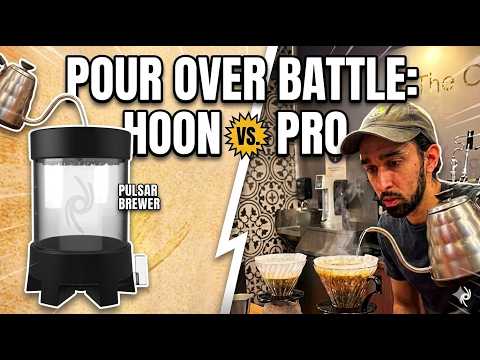
- Watch Hoon's pour-over matchup Can I Brew Better Than A Pro Barista? (Pulsar vs. V60).
- Read about water for coffee.
- Look at choosing a hand grinder.
- Browse the video library for more brews.
Written for this fan-built hub from Hoon's public videos; numbers are starting points, and your beans, grinder and taste have the final say.